

Sentence mining means saving sentences from something you watch or read so you can study them later. With Chinese videos, pick a line you mostly understand, check the unfamiliar word, and keep the sentence’s meaning and original audio or a timestamp. Review it by listening again before checking the answer.
You can use a flashcard app or a note you revisit. Here’s how to choose a sentence and make a review note for it.
Start with a short clip you can follow
Watch enough of the video to know who’s talking and what’s happening. You’ll have a much easier time checking a sentence if you already understand the situation. Our guide to picking Chinese videos for listening practice can help if you’re struggling to find a clip.
For this walkthrough, we wrote a short conversation. Imagine one friend is sitting in a restaurant, waiting for another friend to arrive. They’re talking on the phone:
你快到了吗?你先点菜吧,我马上就到。你快到了嗎?你先點菜吧,我馬上就到。
Pronunciation and meaning
Nǐ kuài dào le ma? Nǐ xiān diǎn cài ba, wǒ mǎ shàng jiù dào.
“Are you almost here?” “Go ahead and order. I’ll be right there.”
These lines are teaching examples written for this guide. The audio buttons use synthetic Mandarin. When you mine a sentence from a video, keep the original speaker’s audio or a timestamp so you can replay it.
Pick a sentence you mostly understand
Suppose you know the rest of the reply but haven’t learned 点菜點菜 (diǎn cài). The Ministry of Education’s dictionary entry describes choosing dishes to order. In this conversation, it means “order food.”
Once you know that, the reply makes sense: the friend who’s still on the way is telling the other person to order first. You’ve found one word to study, with a sentence that shows how someone would use it.
Starting with one unfamiliar word or expression keeps the review manageable. Refold calls this a one-target sentence. After the lookup, you should be able to explain what the whole line means.
A person’s name, a place, or a joke that only makes sense after several episodes may also make the sentence awkward to review. Keep enough of the conversation to understand the reply, or choose a line that makes sense on its own.
Check the caption against the speech
Replay the line while reading the Chinese caption. Check that the word you’re learning is actually what the speaker says. Captions sometimes shorten a line, and automatic captions can get words wrong.
For our example, you’re checking the whole phrase 点菜點菜, rather than trying to learn separate dictionary meanings for 点點 and 菜菜. Listen for it in the full reply:
你先点菜吧,我马上就到。你先點菜吧,我馬上就到。
Pronunciation and meaning
Nǐ xiān diǎn cài ba, wǒ mǎ shàng jiù dào.
Go ahead and order. I’ll be right there.
If you still can’t tell what was said, try a clearer recording or another sentence. There’s no need to make a card from a caption you can’t check.
Save enough to understand it later
Keep the Chinese sentence, the word you’re learning, its meaning in that sentence, and the original audio or video link with a timestamp. Add a short note about the situation if you’ll need it later.
For the conversation above, a review note could look like this:
For a sentence from a real video, add its audio or a link to that moment. Cut out as little as you need: the other person’s question may help you remember why the reply was said.
In Moyu, you can open a caption line’s details and choose Save to keep it in your library with its video position. You can also save words. The screenshot below shows a word review card; Play Example opens a video example for that word.
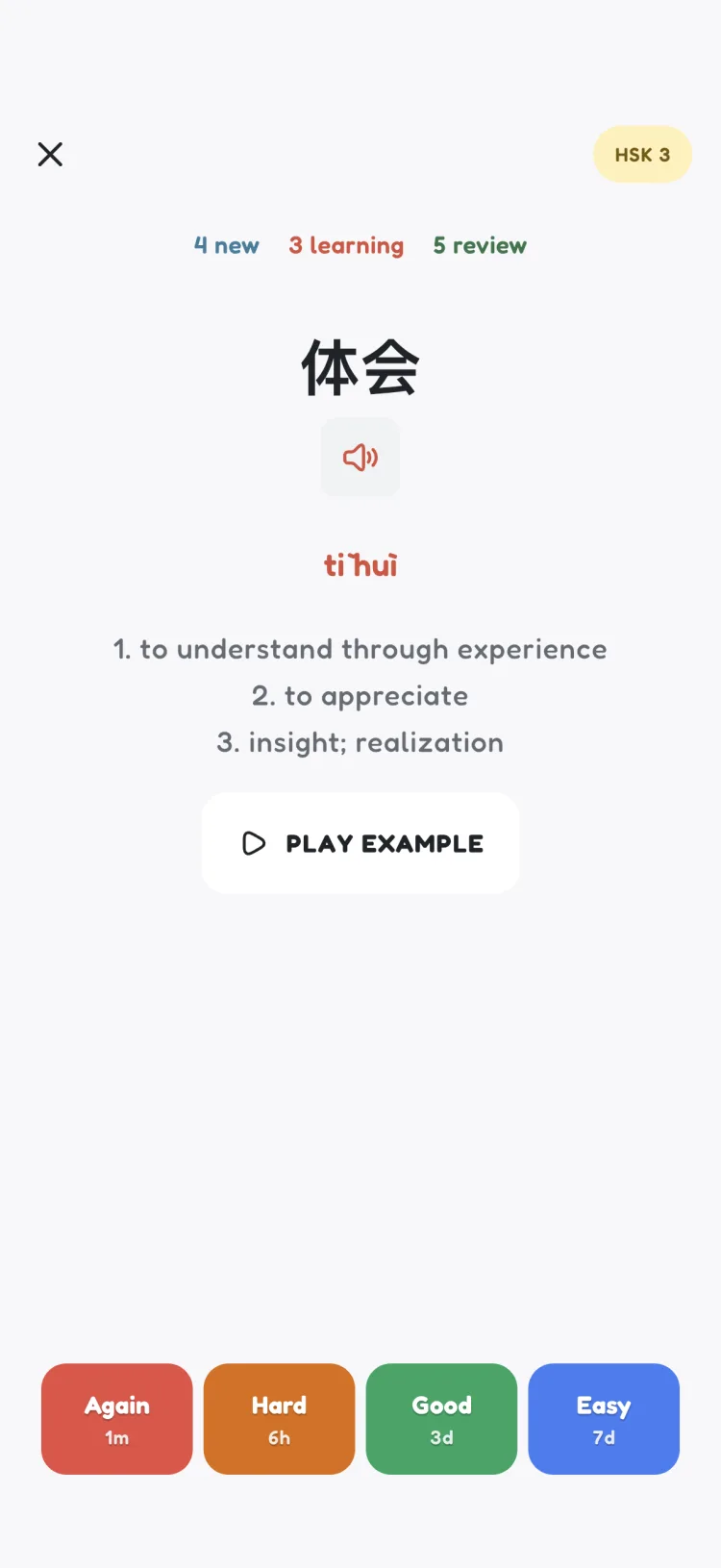
A word review card in Moyu, with Play Example to hear it in a video.
Listen before checking the answer
When you return to the sentence, try this:
- Play the original audio with the meaning hidden. Can you hear the word and understand what the speaker means?
- Reveal the sentence and meaning. If you missed something, check that part and replay the line.
- Hide the answer and listen once more. You should be able to explain the sentence roughly, without memorizing its English translation word for word.
With our restaurant example, the check is simple: do you understand that one friend should order while the other is still on the way? Do you hear 点菜點菜 as “order food” in that reply?
If your flashcard app schedules reviews, follow its schedule and rate cards according to what you remembered. If you’re using a note, come back to it after a break rather than replaying it until you can answer from immediate memory.
Start with one sentence from a clip and see how the review goes. If saved sentences are piling up, spend a session reviewing them before adding more. And if you’re stuck on deciding which word needs a lookup, our Chinese reading lookup guide shows how to make that choice in a short passage.