

When you’re reading Chinese, look up a word if you can’t understand what happens without it. If you can guess its meaning from the sentence, or follow the story without that detail, keep reading. You can check it later; you don’t need to know every word before moving on.
Here’s a short passage written for this example. Read the Chinese once before opening the pinyin and translation.
周六下午,小雨带着一本书去咖啡馆。走到门口,她才发现店今天关门了。她没有回家,而是去了旁边的公园,坐在长椅上读书。週六下午,小雨帶著一本書去咖啡館。走到門口,她才發現店今天關門了。她沒有回家,而是去了旁邊的公園,坐在長椅上讀書。
Pronunciation and meaning
Zhōuliù xiàwǔ, Xiǎoyǔ dàizhe yì běn shū qù kāfēiguǎn. Zǒu dào ménkǒu, tā cái fāxiàn diàn jīntiān guānmén le. Tā méiyǒu huí jiā, érshì qù le pángbiān de gōngyuán, zuò zài chángyǐ shàng dúshū.
On Saturday afternoon, Xiaoyu took a book to a café. At the entrance, she discovered that it was closed that day. Instead of going home, she went to a nearby park and read on a bench.
Did you catch that she went to the park because the café was closed? If so, you followed the story, even if you didn’t know every word.
Guess from the sentence: 长椅長椅
You might not know 长椅長椅 (chángyǐ). But she’s in a 公园公園 (gōngyuán, park), and she 坐在坐在 (zuò zài, sits on) something to read. You can probably guess it’s a seat or bench.
You don’t need the exact word to follow what happened, so you can keep reading. Look it up afterward if you want to learn it.
Skip for now: 旁边旁邊
旁边旁邊 (pángbiān) tells you the park is beside or near the café. But you can follow the story without knowing exactly where the park is. She couldn’t go to the café, so she went to a park instead.
If you don’t know this word yet, you can skip it for now. You can come back to it after reading the paragraph.
Look up: 才发现才發現 and 关门關門
The middle sentence tells you why she went to the park. 才发现才發現 (cái fāxiàn) means she only then discovered something. 关门了關門了 (guānmén le) tells you the shop was closed.
If you don’t understand those phrases, you might miss why she changed her plans. Look them up, then reread the sentence.
After looking them up, read the sentence again: 走到门口,她才发现店今天关门了。走到門口,她才發現店今天關門了。 She reached the entrance and only then found out the café was closed. That explains why she read in the park instead.
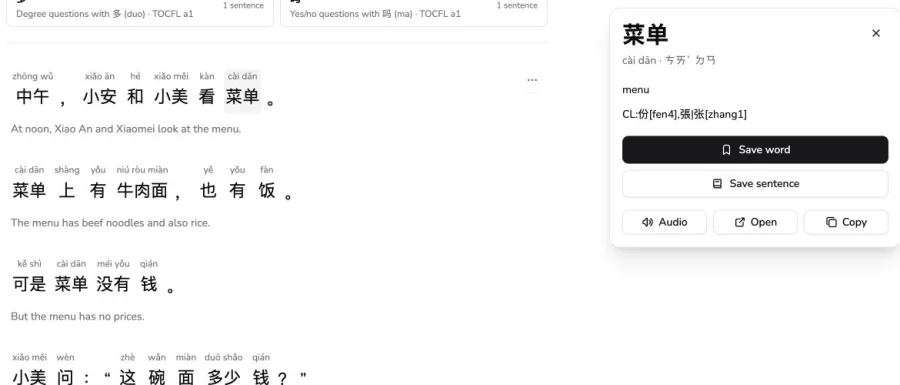
In Miaozi, word definitions open beside the story you’re reading.